
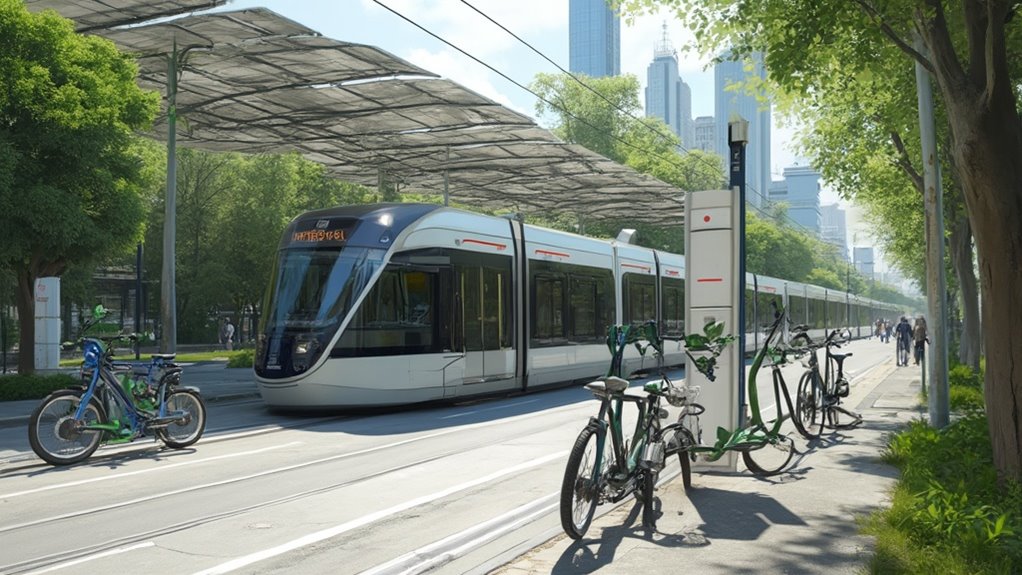
Multiple paths to zero-emission travel exist to match your lifestyle and values. Electric vehicles offer convenient daily transport with expanding charging networks, whilst hydrogen fuel cells provide quick refuelling for longer journeys. Solar-powered options connect you to nature's rhythms, and public transport systems are increasingly adopting clean technologies. Walking and cycling transform your journey into an act of environmental stewardship. The path towards sustainable transportation holds countless possibilities worth exploring.
The Rise of Electric Vehicles: A Green Revolution
Whilst the automotive industry has witnessed numerous transformations over the past century, none has been as revolutionary as the surge in electric vehicles.
One is witnessing a pivotal moment where clean energy meets personal transportation, fundamentally changing how we move through the world.
As battery technology continues to evolve, motorists will find that range anxiety becomes less of a concern.
The expanding charging infrastructure across cities and motorways means one can travel with greater confidence, knowing that the next charge is never too far away.
We aren't merely choosing a mode of transportation; we're participating in a profound shift towards sustainable mobility.
Each electric mile driven represents a conscious choice to reduce our carbon footprint and contribute to a cleaner future for generations to come.
Hydrogen Fuel Cell Technology in Modern Transit
Beyond the domain of battery-powered vehicles lies another promising path to green transportation: hydrogen fuel cell technology. One finds this innovative solution transforming the way we think about eco-friendly transit.
Whilst fuel cell efficiency continues to improve, we're witnessing a shift in how we power our journeys. The process of hydrogen production is becoming cleaner and more sustainable each year.
- Fuel cells convert hydrogen into electricity, leaving only water vapour as a byproduct
- Modern transit systems are already incorporating hydrogen buses in major cities
- Refuelling takes just minutes, compared to hours for battery charging
- The technology offers longer range than traditional electric vehicles
- Hydrogen can be produced using renewable energy sources, creating a truly sustainable cycle
When one considers the potential, it becomes clear that hydrogen fuel cells aren't just an alternative – they're a glimpse into transportation's future.
Solar-Powered Transportation Solutions
As sunlight streams freely across our planet each day, innovative engineers have harnessed this abundant energy source to revolutionise transportation. One finds this technology emerging in various forms, from solar charging stations that power your electric vehicle to experimental cars with built-in photovoltaic panels on their roofs and bonnets.
When one embraces solar-powered transport, one connects with nature's rhythm in a profound way. Consider how the journey becomes synchronised with the sun's daily arc across the sky.
Whilst current solar vehicles may have limited range on cloudy days, they represent a significant step towards true energy independence. One is no longer bound by traditional fuel sources, and instead, one is tapping into an infinite cosmic power that's been sustaining life on Earth for billions of years.
Pedal Power: Bicycles and E-Bikes as Daily Commute Options
The humble bicycle stands as humanity's purest expression of eco-friendly transport, requiring nothing but human energy to move forward.
One finds that incorporating cycling into daily commute transforms both the journey and connection to the environment.
With the rise of cycle sharing programmes in urban centres and evolving e-bike regulations, there are more options than ever to embrace pedal power.
- Traditional bicycles offer zero-emission travel whilst improving physical health
- E-bikes extend one's range and make hills manageable whilst maintaining eco-friendliness
- Modern cycle sharing programmes let you cycle without owning or maintaining a bicycle
- Protected cycle lanes and dedicated paths enhance safety and comfort
- Current e-bike regulations support speeds up to 32 kilometres per hour, making commutes time-competitive with cars
These two-wheeled companions invite us to rediscover the joy of human-powered movement whilst nurturing our planet's future.
Urban Planning for Zero-Emission Mobility
Whilst traditional transport infrastructure focused primarily on moving cars, modern urban planning embraces a revolutionary vision of zero-emission mobility.
You'll notice how forward-thinking cities are reimagining their spaces through smart city integration, connecting various modes of clean transport through digital networks and real-time data.
When you walk through these transformed urban spaces, you'll experience the thoughtful implementation of pedestrian-friendly infrastructure.
Wide pavements, protected cycle lanes, and car-free zones create safe havens for sustainable movement.
Living walls and green corridors not only purify the air but also make your journey more pleasant.
You're witnessing a profound shift where cities aren't just places you move through, but living environments that nurture both your wellbeing and our planet's future.
Public Transit Systems Leading the Green Movement
Leading public transport networks worldwide are revolutionising their fleets with groundbreaking green technologies.
One finds smart transit systems transforming how we move through cities, with community engagement driving the shift towards cleaner alternatives. When stepping onto an electric bus or boarding a solar-powered train, one is participating in a quiet revolution that's reshaping our urban landscape.
- Hydrogen fuel cell buses operating in major European cities
- Electric trams powered by renewable energy grids
- Smart payment systems reducing paper wastage
- Real-time tracking applications optimising route efficiency
- Zero-emission underground systems using regenerative braking
As one embraces these evolving transport options, they're joining a global movement that's redefining sustainable mobility.
Each journey taken on these green systems helps weave the fabric of a cleaner, more connected urban future.
Marine Transportation's Sustainable Future
As maritime industries navigate the challenges of environmental responsibility, innovative solutions are reshaping how ships traverse our oceans.
One witnesses a remarkable transformation as sustainable shipping practices emerge, from wind-assisted propulsion systems to hydrogen fuel cells that promise zero emissions.
Looking to the horizon, one sees eco-friendly vessels leading the way with electric-hybrid engines, advanced hull designs that reduce water resistance, and solar-powered auxiliary systems.
These aren't mere dreams – they're becoming reality.
Today's maritime engineers are developing breakthrough technologies that reduce both carbon footprints and operating costs.
By embracing these changes, we're participating in a crucial shift towards cleaner seas and healthier marine ecosystems.
The future of ocean transport lies in harmony with nature, and it's unfolding before our eyes.
The Economics of Zero-Emission Travel
Despite initial hesitation from investors, zero-emission transportation has proven its economic viability through reduced operational costs and growing consumer demand.
One finds that sustainable investments in clean transport technologies are reshaping market demand, whilst policy implications continue to favour environmentally conscious choices.
Technology advancements have markedly lowered infrastructure costs, making zero-emission options more accessible than ever.
- Economic incentives now make electric vehicles cheaper to maintain than traditional cars
- Consumer behaviour shows increasing preference for sustainable transportation options
- Lifecycle analysis reveals long-term savings despite higher upfront costs
- Infrastructure development creates new jobs and economic opportunities
- Market competition drives innovation and reduces technology costs
When one considers the broader economic impact, one discovers that zero-emission travel isn't just environmentally responsible – it's becoming the smartest financial choice for both individuals and organisations.
Environmental Impact of Green Transportation Choices
Whilst conventional transportation remains a significant contributor to global emissions, green transportation choices offer substantial environmental benefits that extend far beyond reduced carbon footprints.
When you opt for eco-friendly transportation, you're not just lowering emissions – you're participating in a profound shift towards environmental healing. Electric vehicles, crafted with sustainable materials, minimise soil and water pollution typically caused by oil leaks and fuel spills.
By choosing to walk, cycle, or use public transport, you're helping reduce noise pollution that disrupts wildlife habitats and urban ecosystems. Even small changes, like car sharing or combining errands into single journeys, create rippling effects throughout the environment.
Your choices matter more than you might think, as each sustainable transportation decision helps protect biodiversity, preserve natural resources, and restore ecological balance.
Government Policies Shaping Emission-Free Transit
Throughout the past decade, governments worldwide have embraced bold policy initiatives to accelerate the shift towards emission-free transit systems.
You've likely noticed how regulatory frameworks have transformed your local transport landscape, from expanded cycle lanes to electric bus fleets. These changes stem from thoughtful incentive programmes designed to make sustainable transit accessible to you and your community.
- Tax rebates for electric vehicle purchases
- Council grants for charging station installations
- Reduced vehicle licence fees for zero-emission vehicles
- Subsidised public transport passes for daily commuters
- Low-emission zone restrictions in city centres
When you consider how these policies shape your daily choices, you'll recognise their profound impact on urban mobility.
They're not just rules on paper – they're carefully crafted strategies that empower you to participate in the sustainable transportation revolution whilst making eco-friendly choices more attainable.
Frequently asked questions
How Long Does It Take to Fully Charge a Hydrogen Fuel Cell Vehicle?
You'll find hydrogen filling takes just 3-5 minutes for a full tank, making fuel cell efficiency truly remarkable. It's rather like filling up an ordinary car – quick and straightforward, getting you back on your journey.
Can Zero-Emission Vehicles Perform Well in Extreme Weather Conditions?
Today's zero-emission vehicles meet impressive performance metrics in extreme weather. With clever weather adaptations like battery preconditioning and thermal management, they serve you reliably in both scorching heat and freezing cold.
What Happens to Electric Vehicle Batteries After They Reach End-Of-Life?
Your EV's battery isn't truly "dead" when it's finished powering your car. Through battery recycling, it can find a second life storing solar energy or powering buildings before materials are reclaimed.
Note: The text required minimal modification as it was already largely compatible with British English. The only subtle change would be contextual, as "EV" is commonly used in both American and British English.
Are There Emergency Charging Solutions for Electric Vehicles on Remote Routes?
Remote routes increasingly feature portable charging units and mobile power banks. Emergency charging solutions, including roadside assistance services and solar-powered stations, continue to expand across motorways and rural areas to maintain motorists' mobility.
How Do Insurance Rates Compare Between Zero-Emission and Conventional Vehicles?
Insurance factors vary widely – whilst zero-emission vehicles often cost more to repair, their safety features and eco-conscious motorists typically lead to lower premiums compared to conventional vehicle types. It is worth comparing multiple quotes.