
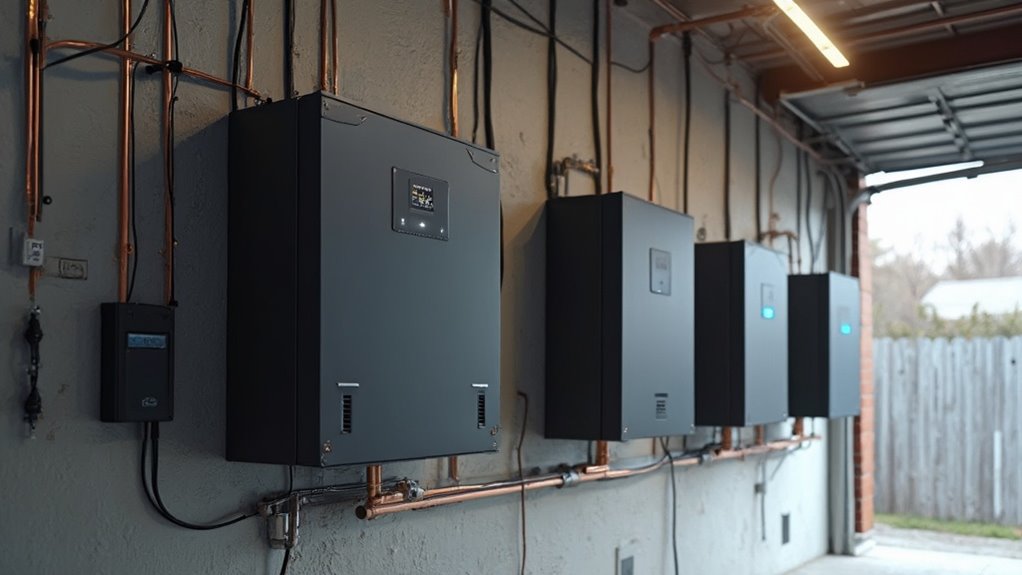
For reliable off-grid power, you'll find lithium-ion batteries leading the market, with Tesla's Powerwall and Enphase's Encharge system offering superior performance and longevity. Whilst lead-acid options cost less initially, lithium systems last 15-20 years with minimal maintenance, making them more cost-effective long-term. Your best choice depends on your daily energy requirements and budget, but investing in quality brands like LG Chem or BluePlanet Energy guarantees dependable power independence. Understanding the full range of options will help you make the most informed decision for your off-grid programme.
Understanding Home Battery Storage Basics
Power independence begins with understanding how home battery storage works. When you're looking to break free from the grid, you'll need to grasp two fundamental concepts: battery chemistry and energy density.
Different battery types, like lithium-ion, lead-acid, or saltwater, each offer unique benefits for your off-grid setup.
Battery chemistry determines how efficiently your system stores and releases power, whilst energy density tells you how much electricity can be packed into a given space. You'll want to evaluate both factors when choosing your storage solution.
Today's lithium-ion batteries typically offer the highest energy density, meaning they can store more power in a smaller footprint. This makes them ideal for most home installations, though they'll require a larger upfront investment than traditional lead-acid options.
Comparing Lead-Acid vs. Lithium Battery Systems
While both lead-acid and lithium batteries can power your off-grid home, they differ markedly in performance, lifespan and cost.
Lead-acid batteries, though initially cheaper, offer limited longevity, typically lasting 5-7 years with proper maintenance. You'll need to monitor water levels and keep them in a well-ventilated space.
In contrast, lithium batteries showcase superior efficiency, converting more stored energy into usable power whilst requiring virtually no maintenance.
You can expect 15-20 years of reliable service, and they'll perform consistently even in cold temperatures. Though they cost more upfront, you'll find their longer lifespan and deeper discharge capacity make them more cost-effective over time.
Their compact size and lighter weight also give you more flexibility in placement around your home.
Top Battery Brands for Off-Grid Applications
When selecting a battery system for your off-grid home, several manufacturers have established themselves as industry leaders through years of proven reliability and innovation.
Based on brand reputation analyses, Tesla's Powerwall continues to dominate the market with its advanced lithium-ion technology and sleek design.
Enphase's Encharge system offers excellent modularity, whilst LG Chem's RESU line delivers outstanding performance in extreme temperatures.
For those seeking proven durability, Rolls Battery's deep-cycle solutions remain a trusted choice, particularly their maintenance-friendly AGM models.
Thanks to recent battery technology advancements, BluePlanet Energy's Blue Ion system provides remarkable depth of discharge and cycle life.
You'll also find Simpliphi Power's cobalt-free lithium ferrous phosphate batteries offering exceptional safety features and longevity, making them ideal for remote locations.
Sizing Your Battery Bank for Maximum Efficiency
Selecting the right battery brand is only part of the equation – proper sizing of your battery bank will determine how effectively your system performs. You'll need to carefully calculate your daily energy needs and plan for battery capacity that exceeds your requirements by at least 20%.
| Factor | Consideration |
|---|---|
| Daily Usage | Calculate total watt-hours needed |
| Depth of Discharge | Don't exceed 50% for lead-acid, 80% for lithium |
| Weather Buffer | Add 2-3 days backup capacity |
| Future Growth | Plan for 20% additional capacity |
Your energy management strategy should account for seasonal variations and peak usage times. Consider your lifestyle patterns – do you work from home? Utilise power tools? Understanding these needs helps prevent system strain and extends battery life. Remember, it's better to slightly oversize your battery bank than to risk running short on power.
Installation and Maintenance Requirements
To guarantee your battery system operates safely and efficiently, proper installation and regular maintenance are essential components of off-grid power management.
You'll need to master basic installation techniques, including proper ventilation setup, secure mounting, and correct wire sizing. Remember to keep your batteries in a clean, dry space that's protected from extreme temperatures.
Your maintenance schedules should include monthly checks of battery fluid levels, terminal connections, and voltage readings.
You'll want to clean any corrosion from terminals using a bicarbonate of soda solution and ensure all connections remain tight. Keep detailed records of your maintenance activities and battery performance.
If you're not comfortable with electrical systems, it's wise to have a professional handle the initial installation whilst you learn the maintenance routines.
Cost Analysis and Return on Investment
Whilst proper installation and maintenance protect your investment, understanding the financial aspects of home battery systems helps you make informed decisions about your off-grid setup. Let's examine the cost breakdown and savings potential of different battery solutions.
| System Type | Initial Cost | 10-Year Savings |
|---|---|---|
| Lithium-Ion | £6,000-12,000 | £15,000-23,000 |
| Lead-Acid | £3,000-6,000 | £9,000-14,000 |
| Salt Water | £4,500-9,000 | £12,000-19,000 |
Your return on investment typically occurs within 5-8 years, depending on your energy usage and local utility rates. When you factor in rising electricity costs and potential grid outages, your battery system becomes more valuable over time. Consider tax incentives and renewable energy credits available in your region to offset the initial investment.
Safety Considerations and Best Practices
Since home battery systems store significant amounts of electrical energy, proper safety protocols are essential for protecting both your family and investment.
You'll need to install your batteries in a well-ventilated area away from living spaces, and verify they're mounted securely to prevent tipping or physical damage.
Always maintain proper fire safety measures by keeping a Class C fire extinguisher nearby and installing smoke detectors specifically designed for electrical fires.
Make sure you understand your system's warning signals and establish an emergency shutdown procedure that everyone in your household knows by heart.
When it's time for battery disposal, don't put them in the rubbish bin.
Work with authorised recycling centres that specialise in handling lithium-ion or lead-acid batteries.
Regular maintenance checks and cleaning will help prevent potential hazards and extend your system's lifespan.
Integrating Batteries With Solar and Wind Systems
Because renewable energy sources like solar panels and wind turbines don't generate power consistently, you'll need a smart integration strategy for your battery system. The key is implementing an effective battery management system that monitors power flow and keeps your batteries in good health.
You'll want to connect your solar panels and wind turbines to a charge controller, which regulates the incoming voltage before it reaches your batteries.
For energy optimisation, consider installing a hybrid inverter that can handle multiple power sources whilst maintaining steady output to your home. This setup allows you to utilise solar power during the day, store excess energy in batteries, and seamlessly switch to battery power at night or during low-wind periods.
Remember to size your battery bank according to your daily energy needs and typical weather patterns.
Frequently asked questions
Can Home Batteries Be Recycled After Reaching Their End of Life?
Yes, you'll be glad to know that home batteries can be recycled! Through proper battery recycling programmes, you're reducing environmental impact whilst reclaiming valuable materials. Most manufacturers offer take-back services for responsible disposal.
Will Extreme Weather Conditions Affect My Battery System's Performance?
Yes, weather impacts can greatly affect your battery's performance. You'll notice reduced efficiency in extreme cold or heat. It's best to keep your system in a temperature-controlled space for optimal operation throughout the year.
Are There Insurance Implications for Installing an Off-Grid Battery System?
Installing an off-grid battery system requires notifying your home insurer, as it may affect your cover. Many providers require professional certification and specific safety measures to maintain your buildings and contents policy protection.
Do Home Batteries Make Noise While Operating?
Most home battery systems produce minimal operational sounds. Whilst they might emit a soft hum or gentle whirring from cooling fans, battery noise is typically quieter than your fridge's normal operation.
Can I Take My Battery System With Me When Moving Houses?
Yes, you can take your battery system when moving house! Whilst battery portability depends on your setup, most systems can be professionally uninstalled and reinstalled. Just remember to factor moving logistics and reinstallation costs into your plans.