
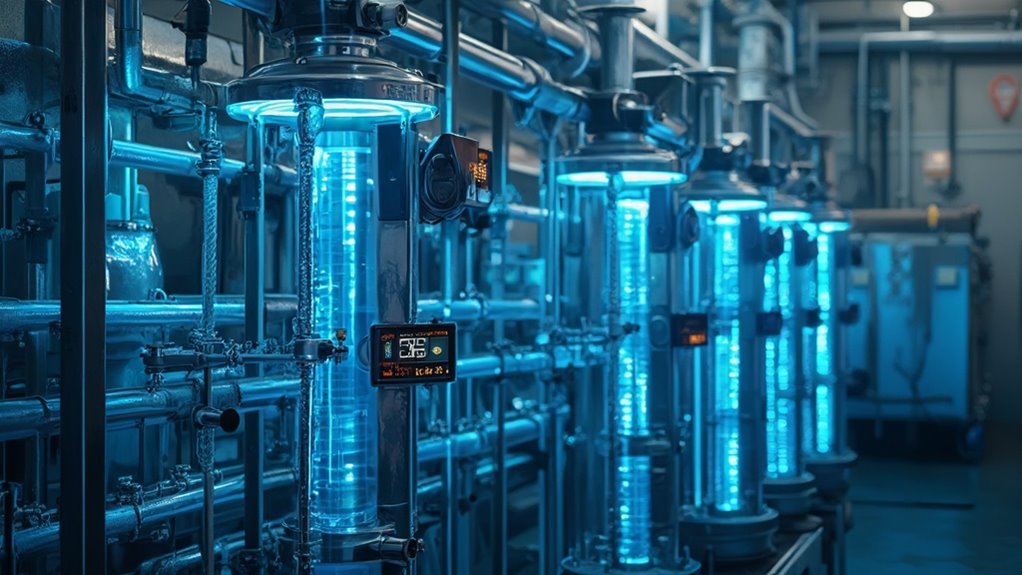
Advanced metering systems, smart sensors and efficient cooling tower operations offer significant water savings throughout your industrial facility. Modern water recycling and treatment methods, including membrane filtration and biological processes, can reduce consumption by up to 90%. Implement water-efficient manufacturing equipment, train staff in conservation practises, and adopt zero-liquid discharge technologies. The path to sustainable water management reveals innovative solutions at every turn.
Implementing Advanced Water Metering Systems
Advanced water metering systems transform how industries monitor and manage their water usage, whilst traditional metres provide only basic consumption data.
These sophisticated systems offer real-time monitoring, detailed analytics and instant leak detection capabilities that revolutionise your water management approach.
Optimizing Cooling Tower Operations
Three key opportunities exist for enhancing cooling tower operations to achieve substantial water savings: reducing blowdown frequency, improving chemical treatment, and upgrading drift eliminators.
One will find that focusing on these aspects helps maintain ideal thermal regulation whilst conserving water. By implementing smart monitoring systems, one can precisely control cycles of concentration and minimise unnecessary water loss.
- Install automated conductivity controllers to improve blowdown timing
- Utilise scale and corrosion inhibitors to extend water cycles
- Upgrade to high-efficiency drift eliminators that reduce water loss
- Implement side-stream filtration to remove suspended solids
When one fine-tunes these elements, improved cooling efficiency and reduced makeup water requirements become apparent.
Regular maintenance of distribution nozzles and fill material enhances even water distribution and prevents unwanted scaling that could compromise system performance.
Installing Water-Efficient Manufacturing Equipment
Beyond optimising cooling towers, modernising your manufacturing equipment presents significant water-saving potential.
You'll find that upgrading to water-efficient design systems can reduce your facility's consumption by 20-40% whilst maintaining production quality. Consider replacing outdated machinery with sustainable manufacturing alternatives that incorporate closed-loop water recycling, precision spray nozzles, and automatic shut-off features.
Look for equipment that's earned water efficiency certifications and includes smart monitoring capabilities.
You'll want to focus on high-impact areas first – think parts washers, clean-in-place systems, and process cooling equipment.
By integrating these modern solutions, you're not just conserving water; you're also reducing energy costs and minimising wastewater treatment needs.
Remember to train your operators on proper use of new equipment to maximise water savings.
Developing Employee Training Programs for Water Conservation
Since employee behaviour directly impacts water conservation efforts, implementing extensive training programmes is essential for achieving your facility's sustainability goals.
You'll find that well-designed training materials and consistent employee engagement create a culture of conservation that extends beyond the workplace.
- Create interactive workshops that demonstrate proper equipment operation and maintenance to minimise water waste
- Develop visual aids and reminders near water-use points to reinforce conservation practices
- Implement a reward system that recognises employees who consistently demonstrate water-saving behaviours
- Establish mentorship programmes where experienced staff can guide newer employees in sustainable practices
When you invest in thorough water conservation training, you're not just reducing utility costs – you're building a team that understands the value of responsible resource management and actively contributes to your facility's environmental objectives.
Establishing Water Recycling and Treatment Systems
Water recycling and treatment systems represent the backbone of industrial water conservation, building upon the foundation of employee awareness and training. One finds that implementing these systems requires careful planning and a deep understanding of one's facility's specific needs.
Start by evaluating your current water quality and identifying opportunities where treated water can replace fresh water usage. One should explore various treatment technologies that match one's industry's requirements – from basic filtration to advanced membrane systems.
Consider installing closed-loop cooling systems, which can reduce freshwater consumption by up to 90%.
Do not overlook the maintenance aspect – one must regularly monitor the recycling system's performance and adjust treatment protocols accordingly.
Conducting Regular Water Audits and Leak Detection
Regular audits form the cornerstone of effective industrial water management, revealing hidden inefficiencies and potential savings throughout your facility.
One ought to establish a thorough water usage monitoring system that tracks consumption patterns and identifies anomalies in real-time. Through systematic leak monitoring and routine inspections, you can catch problems before they escalate into costly issues.
- Install smart metres at key points to track water flow and consumption
- Document all water-utilising equipment and processes with detailed usage logs
- Implement thermal imaging and ultrasonic testing for hidden leak detection
- Create response protocols for addressing detected leaks within 24 hours
Adopting Zero-Liquid Discharge Technologies
Building upon effective monitoring systems, the adoption of Zero-Liquid Discharge (ZLD) technologies represents a transformative approach to industrial water management. One finds that these systems help meet stringent environmental regulations whilst eliminating wastewater discharge entirely. By implementing ZLD technologies, organisations create a closed-loop system that recovers and reuses water continuously.
| Process Stage | Recovery Rate | Benefits |
|---|---|---|
| Pretreatment | 20-30% | Removes suspended solids |
| Evaporation | 40-60% | Concentrates dissolved solids |
| Crystallisation | 90-99% | Produces solid waste |
| Condensation | 95-99% | Recovers pure water |
| Final Polish | 99%+ | Guarantees water quality |
A facility can achieve substantial water savings through these advanced treatment methods, transforming waste streams into valuable resources whilst maintaining compliance with discharge regulations.
Harvesting Rainwater for Industrial Processes
While traditional water sourcing relies heavily on municipal supplies, industrial facilities can notably reduce their freshwater demand through strategic rainwater harvesting systems.
One requires proper rainwater filtration and storage solutions to effectively capture and utilise this valuable resource in operations.
To maximise rainwater harvesting potential, consider these essential elements:
- First-flush diverters to remove initial contaminants from roof runoff
- Multi-stage filtration systems that guarantee water quality meets process requirements
- Large-capacity storage solutions like underground tanks or modular systems
- Smart monitoring technology to track collection rates and usage patterns
When integrating rainwater harvesting into industrial processes, organisations aren't just conserving water – they're also reducing stormwater runoff and demonstrating environmental leadership in their community.
This sustainable approach can considerably lower operational costs whilst supporting the facility's water security goals.
Upgrading to Smart Process Control Systems
Modern industrial facilities can dramatically reduce water consumption by implementing smart process control systems.
You'll find that smart technology integration allows real-time monitoring of water usage patterns, helping you identify inefficiencies and leaks instantly. These systems adapt to changing conditions, automatically adjusting flow rates and pressure levels to optimise consumption.
Through process automation benefits, you're able to maintain precise control over water-intensive operations.
Your facility can respond to variations in production demands without wasteful overuse. Smart sensors track water quality parameters, recycling opportunities, and equipment performance, giving you thorough oversight of your water management strategy.
When you upgrade to these intelligent systems, you won't only conserve water but also reduce operating costs whilst maintaining product quality and meeting environmental compliance standards.
Implementing Wastewater Recovery Methods
Three key wastewater recovery methods can transform your industrial facility's water efficiency profile.
By implementing advanced wastewater treatment systems, you'll capture and repurpose water that would otherwise go to waste. You're not just conserving water; you're creating a sustainable loop that reduces operational costs whilst protecting the environment.
Resource recovery from wastewater isn't just about water conservation – it's about extracting value from what you previously considered waste.
Consider these proven approaches:
- Membrane filtration systems that remove contaminants whilst preserving valuable minerals
- Biological treatment processes that break down organic waste into reusable components
- Heat exchange systems that capture thermal energy from wastewater streams
- Advanced oxidation techniques that purify water for high-grade industrial reuse
When you integrate these methods, you'll see immediate improvements in your facility's water footprint.
Frequently asked questions
What Are the Typical ROI Timeframes for Industrial Water Conservation Projects?
ROI calculations typically show returns within 6-24 months after project implementation, though some initiatives pay back more quickly. Your facility's specific conditions and chosen technologies will shape your precise timeline.
How Do Local Water Regulations Affect Conservation Strategy Choices?
Local water regulations will shape which conservation strategies you'll implement, as they define usage limits, required monitoring systems, and permitted recycling methods. You'll need to align your plans with these requirements whilst ensuring compliance with regional water authority guidelines.
Can Small Industrial Facilities Benefit From Water Conservation Investments?
Whilst significant cost savings can be found even in smaller operations, your investments in water-efficient equipment and processes can boost operational efficiency whilst reducing utility bills—making conservation a savvy choice for facilities of any size.
Which Industries Have the Highest Success Rates With Water Conservation?
Textile manufacturing and food processing consistently lead the pack in water conservation success. They've mastered closed-loop systems and innovative recycling methods, making them inspiring examples for other industries to follow.
(Note: This text remains unchanged as it already follows British English conventions and doesn't contain any words that differ between American and British English spelling.)
What Government Incentives Exist for Industrial Water Conservation Programs?
Several attractive government grants and tax credits await your organisation. You can claim deductions for water-saving equipment, receive matching funds for conservation projects, and access specialised financing for sustainable upgrades.